
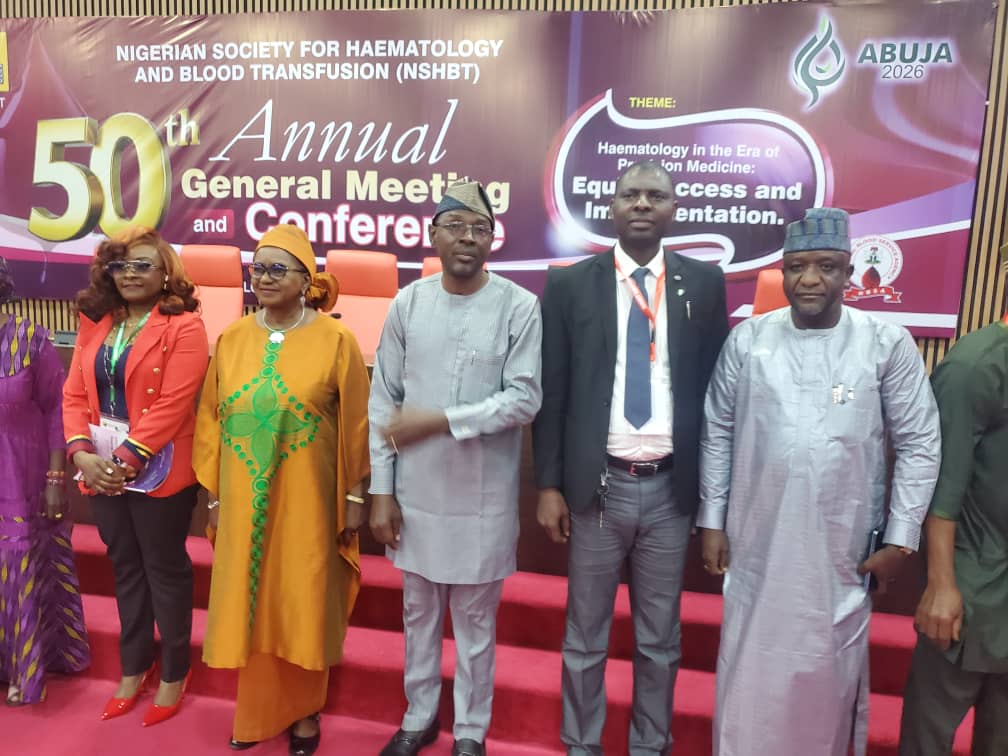
ABUJA — The Minister of State for Health and Social Welfare, Dr. Iziaq Kunle Salako, has said that President Bola Ahmed Tinubu’s administration, through its Renewed Hope Agenda, has revitalised moribund health institutions and introduced reforms aimed at making Nigeria a healthier nation.
Salako stated this on Thursday while declaring open the 50th Annual General Meeting and Scientific Conference of the Nigerian Society for Haematology and Blood Transfusion (NSHBT), held at the Nigerian Army Conference Centre and Suites, Asokoro, Abuja.
The minister expressed delight at joining health policymakers, medical practitioners, traditional medicine practitioners, haematologists and other stakeholders to commemorate the society’s 50th anniversary.
He described the five decades of the society’s existence as a testament to its dedication to human service, noting that the theme of the conference, “Haematology in the Era of Precision Medicine: Equity, Access and Implementation,” was timely and relevant to the country’s healthcare needs.
Salako expressed confidence that the gathering of experienced haematologists would contribute significantly to addressing blood-related disorders and ensuring that Nigerians have access to safe and adequate blood supplies.
According to him, the Federal Government has continued to introduce landmark initiatives in the health sector, including the revitalisation of primary healthcare centres across the country, strengthening of the blood and blood-products value chain, improving the availability of blood products, and the training and retraining of healthcare workers.
He said the various health policies and interventions of the Tinubu administration had made significant positive impacts on the Nigerian healthcare system.
The minister further stated that the Federal Government had expanded healthcare infrastructure and strengthened health institutions across the six geopolitical zones of the country.
Speaking on sickle cell disease, Salako expressed concern over its high prevalence in Nigeria, particularly its implications for vulnerable groups, including pregnant women.
He disclosed that the government had plans under the Renewed Hope Agenda to significantly reduce the burden of sickle cell disease between 2026 and 2030.
Also speaking, the Chairman of the Senate Committee on Health, Senator Dr. Ipalibo Harry Banigo, urged the Director-General and Chief Executive Officer of the National Institute for Cancer Research and Treatment (NICRAT), Prof. Usman Malami Aliyu, to intensify efforts to reduce the burden of cancer in Nigeria.
Banigo called for effective utilisation of healthcare funding and stronger health-security measures, particularly in strengthening emergency medical services.
The senator described President Tinubu as a health-friendly president, saying that the establishment and strengthening of quality health institutions by the Federal Government had enabled Nigerians, including cancer patients, to feel the impact of the Renewed Hope Agenda.
She also highlighted interventions targeting vulnerable groups, including elderly retirees and persons with disabilities, noting that some states, including Bauchi and Ebonyi, had benefited from renewed healthcare and skills-development interventions.
The National President of the Nigerian Society for Haematology and Blood Transfusion, Prof. Kaladada I. Korubo, called on the Federal Government, the Federal Ministry of Health and Social Welfare and NICRAT to establish a stronger working relationship with the society in the fight against cancer and blood-related diseases.
Korubo expressed concern that many Nigerians living with blood cancers were being diagnosed late or having their conditions neglected, often resulting in preventable deaths.
She said the society would continue to partner with NICRAT and other relevant institutions to improve the quality of care available to cancer patients.
According to her, while considerable attention has been given to cancers such as breast cancer, blood cancers also require greater public awareness, early diagnosis and appropriate treatment.
Korubo therefore called for sustained public awareness campaigns on blood cancers to enable Nigerians to recognise the warning signs and seek medical attention early.
She said the 50th annual conference was expected to expose delegates and members of the society to fresh knowledge and developments in haematology, particularly in precision medicine, equity and access to healthcare.
She urged participants to take advantage of the conference to acquire new knowledge and explore improved approaches that could be applied in their respective healthcare centres.
The Secretary of the Nigerian Society for Haematology and Blood Transfusion, Dr. Peter Ogundeji, said haematology had existed as a medical specialty and university discipline in Nigeria for more than five decades.
Ogundeji explained that haematology is a branch of laboratory medicine concerned with the study, diagnosis and management of diseases affecting the blood and blood-forming organs.
He identified sickle cell disease as one of the major blood-related health challenges confronting Nigeria, stressing the need for stronger prevention, diagnosis, treatment and public-awareness strategies.
On possible remedies, Ogundeji identified primary, secondary and tertiary interventions, explaining that the appropriate intervention depends on the nature and category of the condition.
The 50th Annual General Meeting and Scientific Conference brought together haematologists, healthcare professionals, policymakers and other stakeholders to deliberate on emerging developments in haematology and strategies for improving access to quality blood-related healthcare in Nigeria.